
For UK shoppers, the difficult part is often not finding a product but understanding what happens between the first product search and the final order. A practical Kakobuy UK shopping flow starts with discovering a suitable listing, checking its sourcing information, reviewing available QC details, confirming measurements, and only then moving to an external ordering platform. This approach separates product research from checkout and makes each decision easier to verify.
The key point is that the catalog is primarily a discovery and sourcing-information layer. You can compare listings before committing to an order, while the actual purchase is completed through an external shopping agent or ordering platform.
Smart Search Tip: Looking for more? To find items instantly, use single-word keywords (e.g., “SHOES” or “T-SHIRT”) instead of long sentences for the best results.
- Start With the Product, Not the Checkout
- How to Read a Listing Before Ordering
- Compare Listings Before You Commit
- What QC Photos Can Actually Tell You
- Check Measurements Before UK Checkout
- Moving From the Catalog to External Checkout
- What Changes Once the Parcel Heads to the UK?
- Common UK Shopping-Flow Mistakes
- UK Shopping Flow FAQ
Start With the Product, Not the Checkout
A common mistake is to think of an agent-based purchase as one continuous checkout process. It is more useful to treat it as several separate stages: discovery, product evaluation, purchasing through the external platform, warehouse or QC review where available, international shipment, and final delivery.
The first stage is product discovery. The Kakobuy spreadsheet 2026 catalog is designed to make this stage more manageable than scrolling through a large spreadsheet. Category pages and product entries give shoppers a more conventional browsing experience while retaining the sourcing-oriented nature of the underlying data.
For a UK buyer, this separation matters because a product that looks attractive in a listing still needs to pass several checks before money is committed to international shipping. Price is only one part of the decision.
How to Read a Listing Before Ordering
Do not treat every product card as if it provides the same level of information. Some listings may give useful measurements, seller information, product images, colour choices or sourcing links, while others may require more investigation.
Before moving to an external ordering platform, check the information that is actually available rather than filling gaps with assumptions.
- Product type: Confirm that the listing matches the item you are looking for.
- Variant: Check colour, model, configuration or other selectable options.
- Measurements: Look for seller-provided dimensions rather than relying on S, M, L or XL alone.
- Price: Treat the displayed product price as one component of the eventual purchase cost.
- Source information: Confirm that the product has a usable sourcing link or ordering route.
- Available QC information: Determine whether inspection images or other product checks will be available later in the process.
For footwear, for example, the Kakobuy Spreadsheet Shoes category can narrow discovery before you compare individual listings. The same principle works for clothing: start with the relevant product type, then evaluate individual entries rather than assuming an entire category has consistent sizing or quality.
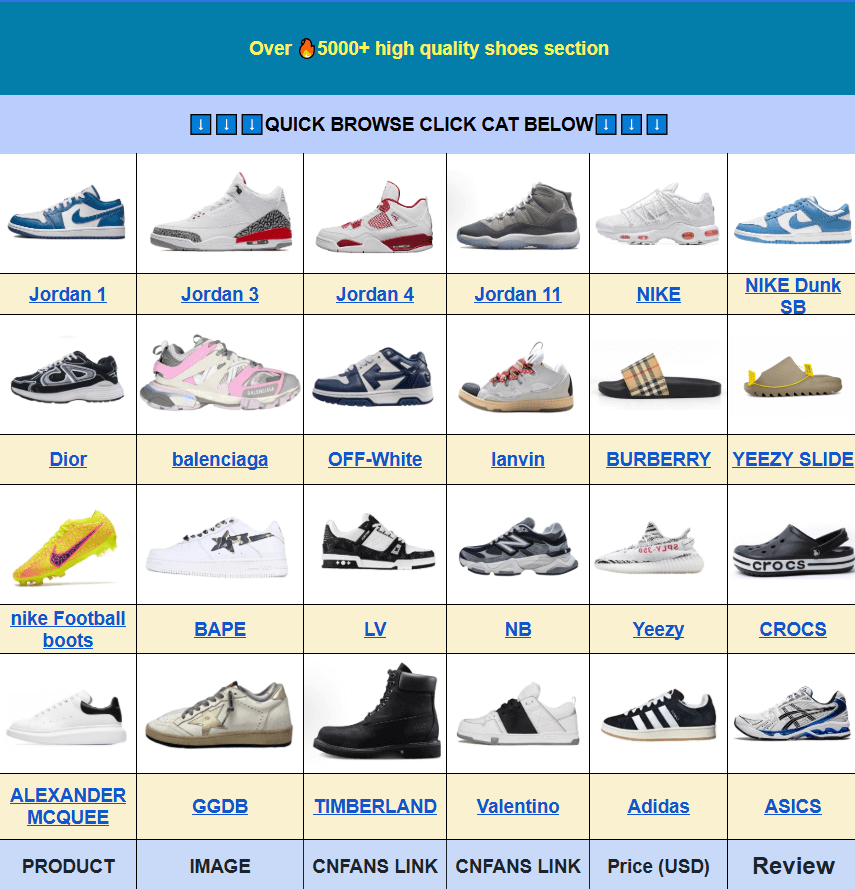
Compare Listings Before You Commit
When several listings appear similar, the useful comparison is rarely just the headline price. A lower product price can be less attractive if the measurements are unclear, the available information is limited, or the resulting parcel configuration creates different shipping considerations.
| Factor | What to Compare | Why It Matters |
|---|---|---|
| Product price | Listed item cost and selected variant | Establishes the starting purchase cost |
| Measurements | Actual seller dimensions or foot-length guidance | Reduces avoidable sizing errors |
| Listing information | Photos, specifications, colours and source details | Shows how much can be verified before ordering |
| QC availability | Whether inspection information can be reviewed | Creates another checkpoint before international shipment |
| Shipping implications | Weight, package dimensions and destination options | Can affect the final delivered cost |
For a UK order, keep the product-selection decision separate from the international-shipping decision. You may identify the right item first and only then decide how to consolidate it, which shipping service to use, and whether the overall landed cost still makes sense.
What QC Photos Can Actually Tell You
QC photos are useful because they provide another visual checkpoint after the product has reached the agent’s handling stage, when such inspection information is available. They should not be treated as a laboratory report or a guarantee of long-term performance.
Look for observable details such as:
- stitching that appears uneven, loose or visibly unfinished;
- colour differences between panels or components;
- graphics or prints that appear noticeably misaligned;
- symmetry and overall shape;
- zippers, buttons, buckles and other visible hardware;
- logos, tags and labels where they are visible;
- for shoes, outsole construction, visible glue marks, shape and left-right symmetry;
- obvious scratches, stains, dents or other visible defects.
What a photo cannot reliably establish is equally important. Images cannot definitively prove fabric composition, chemical composition, long-term durability, months of comfort, or how a product will perform after repeated use.
A sensible QC review therefore asks a narrower question: Is there anything visible that conflicts with the product information or the buyer’s requirements? If the answer is yes, resolve that issue before international shipment when the ordering platform provides a suitable process for doing so.
Check Measurements Before UK Checkout
Sizing is one of the easiest places for an international order to go wrong because manufacturer dimensions do not necessarily follow UK retail conventions. A UK shopper who normally buys a certain size should not assume that the same label will produce the same physical dimensions from another manufacturer or batch.
For clothing, compare measurable specifications such as chest width, shoulder width, sleeve length, garment length, waist and hip measurements. For footwear, foot length and available insole information can be more useful than a generic size label.
| Product | Useful Measurement | Practical Comparison |
|---|---|---|
| T-shirts and tops | Chest width, shoulder width, length | Compare against a garment you already own |
| Hoodies and jackets | Chest, shoulder, sleeve and length | Allow for the intended fit and layering |
| Pants and shorts | Waist, hip, rise and length | Compare with a well-fitting pair |
| Shoes | Foot length and insole length | Measure your foot and check the seller’s dimensions |
If a listing only provides S/M/L/XL and gives no useful measurements, the uncertainty is higher. That does not automatically make the item unsuitable, but it means the shopper has less measurable information on which to base the decision.
Moving From the Catalog to External Checkout
Once the product passes the initial checks, the next step is to follow its sourcing or ordering route to the external shopping agent. This is where the website’s role changes from discovery to handoff.
The basic sequence is:
- Save the product details: Record the listing, selected variant and relevant measurements.
- Open the sourcing route: Follow the available product link or ordering route.
- Confirm the variant again: Check colour, size and configuration on the external platform.
- Review the estimated purchase and service costs: Product cost and international shipping are separate components.
- Place the order through the external platform: The external provider handles the transaction and its associated ordering process.
- Use available QC or warehouse information: Review inspection information when provided before deciding whether to proceed with international shipment.
This workflow reduces a surprisingly common error: choosing a product in one browser tab and accidentally ordering a slightly different variant in another. Keeping the exact colour, measurements and product reference together makes the handoff easier to verify.
What Changes Once the Parcel Heads to the UK?
After product selection, the economics of the order can change because international shipping becomes a major part of the calculation. The final amount depends on factors such as parcel weight, dimensions, destination, shipping route, carrier, service level and the options offered by the external platform.
Volumetric weight can also matter for bulky products. Removing unnecessary outer packaging may sometimes reduce parcel volume, but the appropriate approach depends on the product and the shipping service. Do not remove packaging simply to save space if it is needed to protect a fragile item.
For UK deliveries, shoppers should also distinguish between the purchase process and the import process. Customs treatment, VAT arrangements and carrier procedures can vary according to the shipment and current UK rules. A platform may offer different shipping methods, but the buyer should check the applicable terms rather than assuming that a particular service always includes every tax or import charge.
For international buyers more generally, the same principle applies. UK, EU, US, Canadian, Australian and New Zealand import arrangements are not interchangeable. If you are ordering from outside the UK, check the current customs and tax guidance relevant to your destination.
Common UK Shopping-Flow Mistakes
Ordering before checking dimensions
A familiar size label is not enough when manufacturer sizing varies. Measurements provide a much stronger basis for comparison.
Confusing product cost with delivered cost
The item price does not necessarily represent the total amount paid to receive the parcel. International shipping and any applicable taxes or charges need to be considered separately.
Assuming QC photos prove everything
Inspection images are visual evidence. They are useful for visible defects and construction details, but they cannot establish every characteristic of a product.
Skipping the variant check
A product can have several colours, sizes or configurations. Verify the selected option again when transferring the order to the external platform.
Ignoring parcel dimensions
A lightweight but bulky parcel can have different shipping implications from a compact parcel with the same actual weight. Packaging decisions should therefore be considered before final shipment.
Assuming UK rules apply everywhere
The workflow described here is UK-focused. A buyer sending a parcel to Germany, Australia, the United States or another destination should verify the rules and available shipping options for that destination instead of copying a UK assumption.
UK Shopping Flow FAQ
Q: What is the Kakobuy UK shopping flow?
A: It is the sequence from finding a product in the web catalog, checking its sourcing information and specifications, reviewing available QC details, transferring the product to an external ordering platform, and arranging international shipment.
Q: Does the website complete the final purchase?
A: The website functions primarily as a product discovery and sourcing-information catalog. The actual transaction is completed through the external shopping agent or ordering platform associated with the product.
Q: Should I use my normal UK clothing size?
A: Not automatically. Compare manufacturer dimensions with measurements from a garment that fits you well. Size labels can vary between manufacturers and batches.
Q: What should I look for in QC photos?
A: Focus on visible issues such as stitching, colour consistency, symmetry, print placement, hardware and obvious defects. Photos cannot definitively establish fabric composition or long-term durability.
Q: Does the product price include UK delivery?
A: Not necessarily. Product cost and international shipping are separate parts of the purchasing process, and the final shipping amount depends on the destination, parcel characteristics and selected service.
Q: Can packaging affect international shipping?
A: Yes. Parcel dimensions can influence shipping calculations, particularly for bulky packaging. Any packaging reduction should balance potential space savings against the protection the product needs.
Q: What should UK shoppers check before shipment?
A: Reconfirm the product variant, available QC information, measurements, parcel details and selected shipping service. Also check current UK customs and tax guidance where applicable.
The most reliable way to approach this type of purchase is to keep each stage separate: discover the product, verify the measurable details, inspect what can realistically be inspected, and only then move to external checkout and international shipping. That turns a potentially confusing spreadsheet-to-order process into a sequence of smaller decisions that can be checked before the parcel leaves the sourcing stage.